


Table of Contents
- Start with a Wardrobe Audit and How to Declutter Your Closet
- Choose a Minimalist Style Color Palette
- Your Capsule Wardrobe Checklist: Essential Pieces to Own
- How to Build a Minimalist Wardrobe for Work and Weekends
- How to Build a Minimalist Wardrobe That Flatters Your Body Type
- Maintain Your Minimalist Wardrobe: Care, Rotation, and Repairs
- Sustainable Ways to Dispose of Decluttered Clothing
- Conclusion
- Frequently Asked Questions
Last Updated: September 29, 2026
Start with a Wardrobe Audit and How to Declutter Your Closet
The fastest way to learn how to build a minimalist wardrobe is to start by removing what you don't wear. A wardrobe audit is a structured review of every item you own, sorting each piece into keep, donate, or discard piles based on fit, condition, and how often you actually wear it.
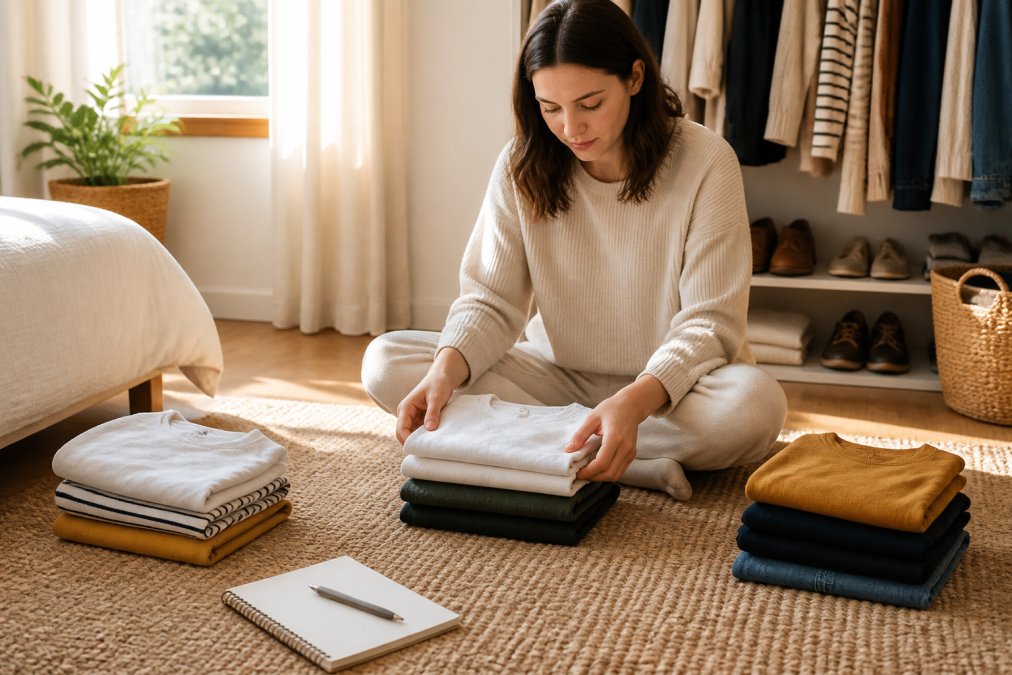
Here's a simple decluttering method that works:
- Make three piles: keep, donate, discard
- Try on every item, no exceptions
- Set aside anything unworn for 12 months
- Flag items needing repair for a decision within one week
- Count your keeps before moving on
Choose a Minimalist Style Color Palette
A minimalist style color palette is a small, fixed set of colors that all your clothes share, so nearly everything matches. Most wardrobes work best with two or three base colors plus one or two accents.
Your Capsule Wardrobe Checklist: Essential Pieces to Own
A capsule wardrobe checklist is a fixed list of wardrobe staples that mix and match into dozens of outfits. The exact count matters less than coverage: you want enough tops, bottoms, layers, and shoes to dress for your actual week.
| Category | Essential Items | Suggested Count |
|---|---|---|
| Tops | Plain tees, button-down, fine-knit sweater | 6-8 |
| Bottoms | Dark jeans, tailored trousers, shorts or skirt | 4-5 |
| Layers | Blazer, cardigan, light jacket | 3-4 |
| Shoes | Everyday sneakers, boots, dress shoes | 3 |
| Accessories | Belt, scarf, simple jewelry | 3-5 |
How to Build a Minimalist Wardrobe for Work and Weekends
Separating work and weekend pieces is where most minimalist wardrobes break down. The fix is overlap: choose items that move between both settings with one change, like swapping sneakers for loafers or adding a blazer.
- A neutral blazer that dresses up a tee
- Dark, well-fitted trousers
- A fine-knit sweater in a base color
- Clean leather or canvas shoes
- One accent layer, like a scarf or cardigan
How to Build a Minimalist Wardrobe That Flatters Your Body Type
- Where is your natural waist? (The narrowest point between your ribs and hips, not where your pants sit.)
- Which vertical line do you want to emphasize, shoulders, waist, or hips?
- Which horizontal line do you want to soften, shoulders, midsection, or hips?
| Silhouette goal | What it does | Capsule pieces that deliver it |
|---|---|---|
| Balance shoulders and hips | Softens a wide shoulder or adds visual width at the hip | V-neck knits, straight or bootcut trousers, A-line skirts, structured blazers with a nipped waist |
| Define the waist | Creates an hourglass read on a straight or apple frame | Wrap tops, belted cardigans, high-rise trousers, tucked fine-knit sweaters |
| Elongate vertically | Adds height and a continuous line on a petite or balanced frame | Monochrome base colors, high-rise straight-leg pants, longline cardigans, pointed-toe flats |
| Add structure | Gives shape to a soft or narrow frame | Blazers with defined shoulders, tailored trousers, crewneck sweaters, leather belts |
- Shoulder seam sits at the shoulder bone. If it hangs past it, the piece will look borrowed no matter how good the fabric is.
- Waistband doesn't gap or dig. A tailor can take in a waistband for a modest fee, often less than the cost of replacing the item.
- Hem breaks where you want the eye to stop. Cropped hems draw attention up; full-length hems lengthen the leg line.
A common pattern is that people own three or four pieces that genuinely flatter them and a closet full of pieces that almost work. The minimalist move is to identify those three or four, note their exact cut, rise, and neckline, and replace the almost-works with more of the same. You don't need a stylist, you need a tape measure, a mirror, and the discipline to stop buying shapes that don't match your strategy.
Maintain Your Minimalist Wardrobe: Care, Rotation, and Repairs
A small closet only pays off if the pieces in it survive. The math is simple: a $120 sweater worn twice a week for three seasons costs about $2 per wear. The same sweater worn twice a week for one season before it pills and stretches costs about $6 per wear. Maintenance is what closes that gap, and it's the step almost every minimalist wardrobe guide skips.
Wash less, and wash colder
Most everyday garments don't need a wash after one wear. Air them overnight on a hanger, spot-clean stains immediately with cold water and a drop of dish soap, and reserve full washes for actual soil. When you do wash:
- Turn knits and dark denim inside out to reduce surface abrasion.
- Use cold water on a gentle or delicate cycle, heat is what shrinks cotton and fades dye.
- Skip fabric softener on anything absorbent; it coats fibers and reduces breathability.
- Air dry flat for knits (hanging stretches shoulders) and on a line or rack for wovens.
Rotate seasonally, but store correctly
Twice a year, typically when you switch clocks or change bedding, pull out-of-season items and store them. The rules that matter:
- Clean before storing. Moths and stains both attack fabric that sits for months. A single missed food stain can become a permanent hole.
- Fold knits, hang wovens. Hanging a heavy sweater stretches it out of shape; folding a structured blazer crushes the shoulder line.
- Use breathable containers. Cotton storage bags or acid-free boxes beat vacuum-sealed plastic, which traps moisture and can yellow whites.
- Add cedar or lavender. Cedar blocks and sachets deter moths without the chemical smell of mothballs. Refresh them once a season by lightly sanding the cedar.
Repair early, and keep a kit
A loose button or a pulled hem is a five-minute fix that becomes a replacement purchase if you ignore it for six months. Keep a small kit in a drawer near your closet:
- Matching thread in your base colors (black, navy, gray, white, cream)
- A needle, a seam ripper, and small scissors
- Spare buttons saved from every garment you buy
- Iron-on hem tape for quick fixes before a proper stitch
- A lint shaver for pilling knits
Review each season
At the end of every season, spend 15 minutes with your closet. Pull out anything you didn't wear, anything that needs a repair you've been postponing, and anything that no longer fits. Decide within a week: repair it, tailor it, or release it. A minimalist wardrobe isn't static, it's a small, well-maintained set of pieces that earns its space every season.
Sustainable Ways to Dispose of Decluttered Clothing
Throwing purged clothes in the trash is the easiest option and the worst one. Sustainable fashion starts with keeping textiles in use, so plan disposal before you start decluttering.
Conclusion
Building a minimalist wardrobe is less about owning fewer things and more about choosing better ones you'll actually wear. Ace Shop makes that easier with a wide variety of quality products in one place, carefully selected items that combine style, functionality, and value, and affordable pricing across clothing, home, and everyday essentials. Get started with Ace Shop and build a functional closet that fits your real life.
Frequently Asked Questions
What is the 3-3-3 rule for a minimalist wardrobe?
The 3-3-3 rule is a packing and wardrobe simplification method: choose 3 tops, 3 bottoms, and 3 pairs of shoes to create 27 different outfits. It works as a starting point for building a minimalist wardrobe because it forces you to focus on versatility and neutral colors. You can expand the rule to 5-5-5 once you are comfortable. The key is picking pieces that mix and match easily, like a white tee, dark jeans, and simple sneakers.
How do I start building a minimalist wardrobe from scratch?
Begin with a wardrobe audit: empty your closet and sort every item into keep, donate, or toss. Then define your lifestyle needs (work, casual, events) and choose a neutral color palette. Use a capsule wardrobe checklist to identify gaps, and buy only high-quality pieces that fill those gaps. Aim for around 30-40 items total, including shoes and accessories. Focus on cost-per-wear and versatility rather than trends.
How many items should be in a minimalist wardrobe?
There is no universal number, but most minimalist wardrobes range from 30 to 50 items, including shoes and accessories. The exact count depends on your climate, profession, and daily activities. A good rule is to keep only what you wear regularly and what makes you feel confident. If you wear 80% of your clothes 20% of the time, you likely have too many. Start with a capsule wardrobe checklist and adjust based on your actual needs.
What is the 90-90 rule for decluttering clothes?
The 90-90 rule states that if you haven't worn an item in the last 90 days, and you won't wear it in the next 90 days, you should let it go. This helps you identify clothes that no longer serve your lifestyle. Exceptions include seasonal items like heavy coats or formal wear. Apply the rule during your wardrobe audit to make objective decisions and reduce emotional attachment to unworn pieces.
How do I choose a color palette for a minimalist closet?
Start with 2-3 base neutral colors (black, white, gray, navy, beige) that flatter your skin tone and dominate your wardrobe. Then add 1-2 accent colors for variety, like olive green or burgundy. This minimalist style color palette ensures everything mixes and matches. Test by laying out your clothes: if most pieces work together, your palette is cohesive. Avoid too many bright or patterned items that limit outfit combinations.
What is the 5-4-3-2-1 method for a minimalist wardrobe?
The 5-4-3-2-1 method is a packing technique that can also guide wardrobe building: choose 5 tops, 4 bottoms, 3 dresses or layers, 2 pairs of shoes, and 1 accessory. This creates a small, versatile capsule for travel or everyday. It forces you to prioritize mix-and-match pieces. Use it as a mini capsule wardrobe checklist when you want to test minimalist principles before committing to a full closet overhaul.
How do I maintain a minimalist wardrobe over time?
Schedule a seasonal rotation: store off-season clothes and bring only current-season items into your main closet. Follow garment care labels to extend the life of your investment pieces. Repair small issues like loose buttons or hem tears promptly. Do a quick monthly audit to remove anything you haven't worn. This upkeep prevents clutter from creeping back and keeps your minimalist wardrobe functional and intentional.
What should I do with clothes I no longer wear?
Instead of throwing them away, donate wearable items to local charities or shelters. Sell higher-quality pieces through consignment shops or online resale platforms. For worn-out textiles, look for recycling programs that turn fabric into insulation or new fibers. Some brands offer take-back programs for old clothes. Sustainable disposal reduces your fashion footprint and gives your decluttered items a second life.